
Routebase keeps your docs, mocks, and tests in sync with your API
Your agents write an endpoint in minutes, so the docs, mocks, and tests fall behind faster than anyone can check by hand. Routebase makes one living spec the single source of truth, so your agents design against your style guide and you test your endpoints end to end against the live API.
14-day Pro trial, no credit card required.
- Free plan, no credit card
- Hosted in the EU or the US
- Every feature reachable over MCP

How it works
Change the spec once. Everything else follows.
- 01
Design
You design the contract in the visual OpenAPI editor, or you import the spec you already have.
- 02
Publish
You publish a version, and Routebase generates the docs portal and the mock server from it. Your tests and monitors validate against that same version.
- 03
Build against it
Frontend builds against the mock, QA runs the suites in CI, and agents work the same spec over MCP.
- 04
Catch drift
Monitors replay live responses against the spec, so a field that drifts shows up as a diff before a consumer sees it.
Product tour · 45 seconds
See it in action
- 01Your agents design against your team's style guide.
- 02The mock server answers from that contract right away.
- 03When you publish, the docs come from the same source.
- 04When the live API stops matching, you see the field that broke it.
The lifecycle
Run the whole lifecycle from one spec
1.0
API Design
Design the contract first
Design OpenAPI specs in a visual editor with endpoints, schemas, and versions, so nobody hand-edits YAML.
- 1.1Visual editor
- 1.2Reusable schemas
- 1.3Spec branches
- 1.4Governance rules

What keeps it in sync
Agents, drift checks, and spec branches work on the same contract.
Your APIs become agent tools
Routebase ships an MCP server out of the box, so agents design, lint, and test through the same interface your team uses without any glue code.
- The full feature set, exposed as MCP tools
- Agents create endpoints, run test suites, and lint specs
- Lint the spec against your style guide, straight from the agent
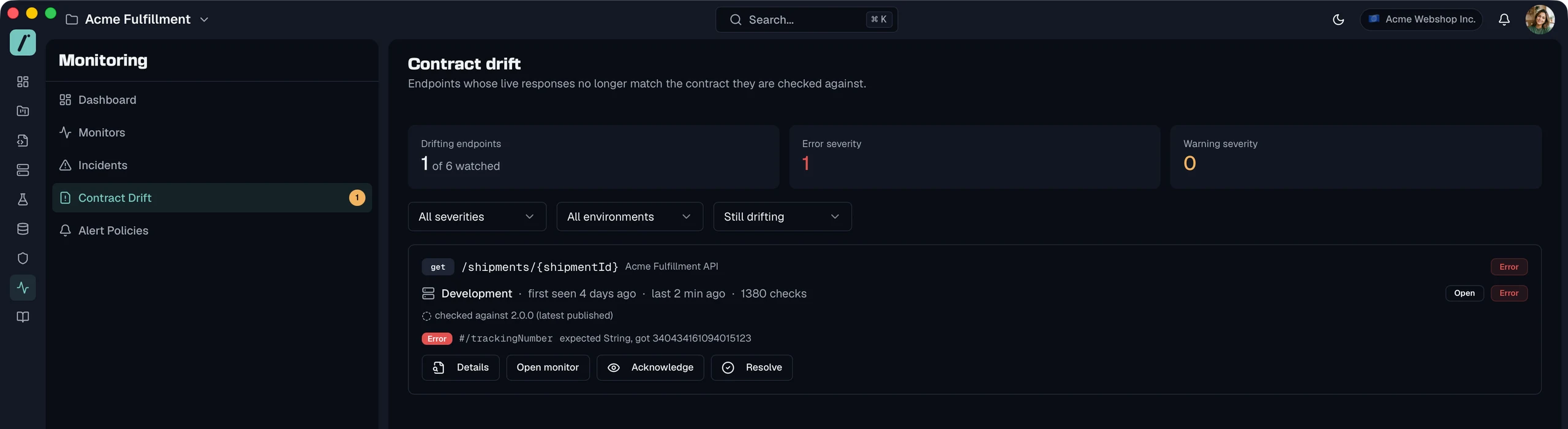
Catch drift before your consumers do
Scheduled monitors validate live responses against your spec and flag every divergence, from missing fields and type mismatches to undocumented additions.
- Live responses validated against the spec, continuously
- Breaking changes flagged with field-level diffs
- Every divergence classified, from missing fields to type mismatches
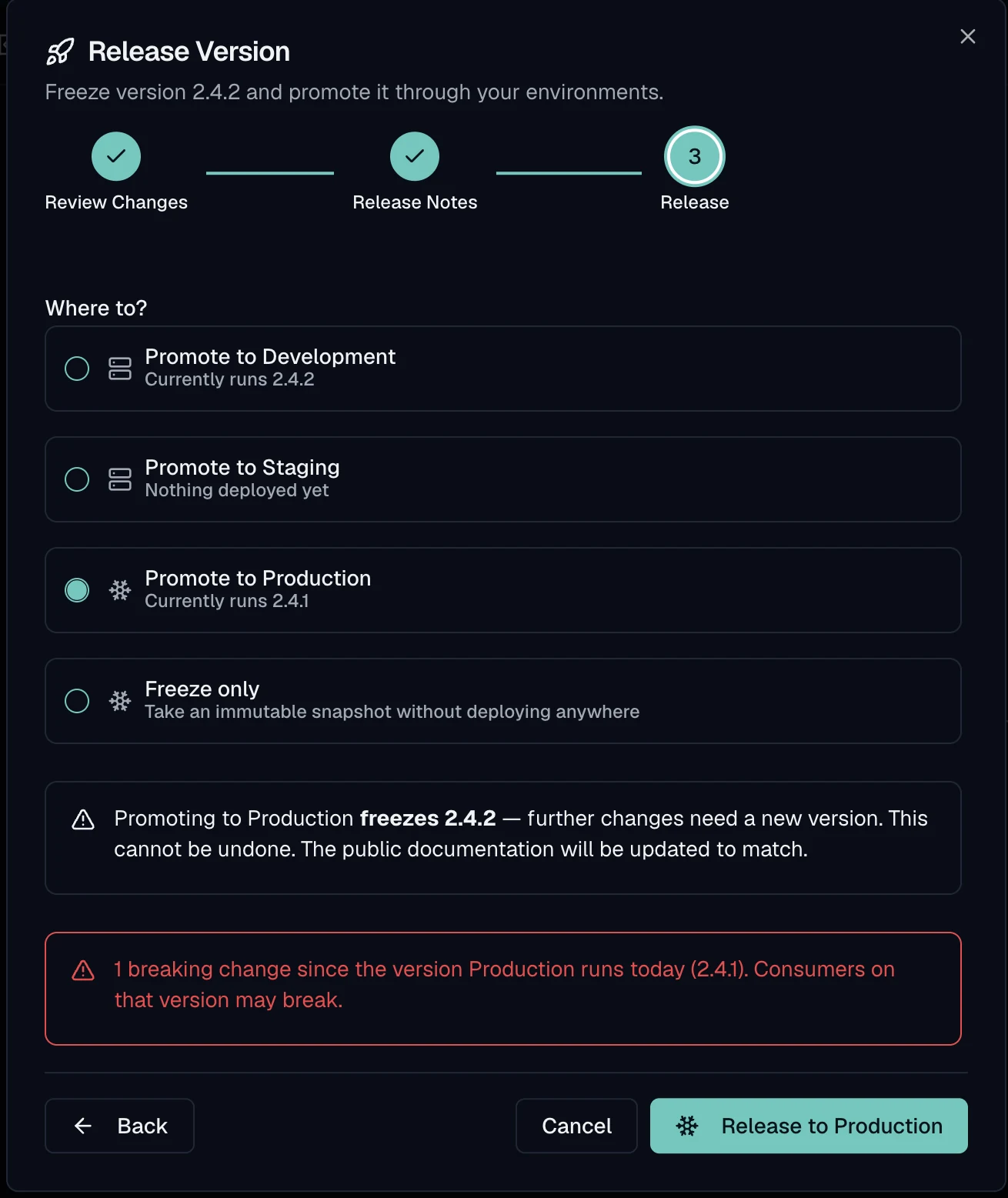
Branch, review, and merge your specs
Draft on a spec branch, open a merge request, ship what survives review. Breaking-change checks built in.
- Spec branches isolate work in progress
- Merge requests with review and approval flow
- Conflict and breaking-change detection before merge
Pricing that scales with your team
Every account starts with a 14-day Pro trial — no credit card required.
Per user, per month. Prices exclude VAT.
Free
For trying Routebase and small personal projects.
- 1 user, 2 projects
- 1,000 mock requests/mo
- Auto-generated docs portal
- OpenAPI import & export
Starter
For small teams getting their API workflow in order.
or $11 billed monthly
- Unlimited users, 10 projects
- 10,000 mock requests/mo
- Scheduled test runs
- Email support
Pro
For teams running their whole API lifecycle in one place.
or $23 billed monthly
- Unlimited projects & specs
- 100,000 mock requests/mo
- Spec branches & merge requests
- Governance & security scanning
- Monitoring & alerts
- Custom domain for your docs portal
Enterprise
For organizations with compliance and identity requirements.
or $45 billed monthly
25 seats minimum — self-service, no sales call
- SAML SSO & SCIM provisioning
- Unlimited mock requests & monitors
- Audit log export
- Dedicated support & SLA
Frequently asked questions
What is Routebase?
Routebase is an API design, testing, and documentation platform built on one living OpenAPI spec. You design the contract in a visual editor, and the mock server, the test suites, and the published docs derive from that same spec, so they stay in sync when the API changes. A built-in MCP server lets agents work the same spec under your team's permissions.
Do I still need Routebase if I use AI coding agents?
Yes, because an agent makes it cheap to change an API, so the docs, mocks, and tests drift apart faster than anyone can check by hand. A generated test or doc page reads plausibly, but it doesn't tell you whether it still matches the API that's live. Routebase keeps one living spec as the single source of truth, and a contract test turns red when your live API stops matching it. Your agents run those tests themselves through the built-in MCP server, so they see what failed and fix it before anyone reviews the change. Because every docs portal also serves llms.txt and Markdown, the agents that call your API read the same contract as your team.
How does the 14-day Pro trial work?
Every new account starts on a full Pro trial — all features unlocked for 14 days. No credit card and no plan selection; the trial starts the moment you sign up.
What happens when the trial ends?
Your workspace automatically moves to the Free plan. Nothing is deleted — projects, specs, and history are retained, and you can upgrade any time to pick up where you left off.
Do I need a credit card to get started?
No. You only enter payment details when you choose a paid plan.
Where is my data stored?
You choose EU or US data residency when you sign up, and your workspace stays in that region. Both regions run on Microsoft Azure.
What if I don't have an OpenAPI spec?
You don't need one to start. Create an empty specification and add endpoints in the visual editor, or begin from a CRUD or auth template — Routebase writes the OpenAPI for you as you go. Testing needs no spec at all: a test case is a plain HTTP request, and linking it to an endpoint is optional. Most APIs arrive here undocumented; the spec is what you leave with, not what you bring.
Can I import my existing APIs?
Yes — import OpenAPI specs directly, or bring collections from Postman or Insomnia; example request bodies become schemas on the way in. No file at all? Start from an empty spec or a template. From there, your spec is the single source of truth.
Can Routebase replace Postman for API testing?
Yes. A test case is a plain HTTP request with the auth scheme the endpoint needs — ten schemes, from Bearer and API key to OAuth2 and AWS SigV4. Assertions are declarative: six types (status, body, header, JSON path, latency, schema) with ten operators, so there are no test scripts to maintain when the team changes. Chain cases into scenarios that pass extracted values downstream, run a suite once per row of a data set, put it on a cron schedule, or gate CI with the CLI and GitHub Action. OWASP API Top 10 scanning ships alongside, with a CI gate of its own. A Postman or Insomnia collection imports as a specification, and one click generates a test case per endpoint from it. None of it requires an OpenAPI spec to begin with.
How do AI agents connect to Routebase?
Every workspace exposes a built-in MCP server. Agents like Claude or Cursor discover your APIs as tools and can design, lint, and test specs — under the same permissions as your team.
Is Enterprise really self-service?
Yes. Enterprise starts at 25 seats and you subscribe directly in the app — SAML SSO, SCIM, and audit log export included. No sales call required.
Can I buy Routebase through Microsoft Marketplace?
Yes. Starter, Pro, and Enterprise are listed on Microsoft Marketplace at the same USD list prices, billed by Microsoft on your existing account and shown in your local currency. Starter and Pro include the 14-day free trial there too; the Free plan is available directly on routebase.dev.
Can I cancel anytime?
Yes, in one click. Your plan stays active until the end of the billing period, then the workspace downgrades to Free with all data retained.
Ready to ship on it?
Routebase is live. Design your API once — docs, mocks, tests, and monitoring all follow from the same source.
14-day Pro trial — no credit card required.